
I sat at dinner with my good
friend Lisa who writes non-fiction and bragged that I was well into Book Five
of a six book series. “How does it turn out?” Lisa asked.

“I don’t know yet?”
“But how does Book Five turn
out?”
“I’m not certain yet.”
“Well, surely you have an
outline.”
“Um, I have a genealogy to
keep the ages of the young characters straight. And I have a map. Well, a
partial map,” I said.
“No wonder you’re stuck.”
“I’m not stuck. I just have
to be patient and allow events to unfold organically.”
“How do you tolerate the
uncertainty?”
“You know that myth about
how all writers are alcoholics…”
“That’s not funny.”
 How do I tolerate the
uncertainty? How can I explain the process to you, dear reader, or to a fellow
writer? I have known long periods of no writing and no creative impulses. It’s
like being deaf. Some days I’m paralyzed with fear. Some days I want to throw
the whole project out the window, except that’s the same a suicide – identity
suicide. Some days I’m so racked with feelings of failure that I, well, let’s
just say that I cry in my beer.
How do I tolerate the
uncertainty? How can I explain the process to you, dear reader, or to a fellow
writer? I have known long periods of no writing and no creative impulses. It’s
like being deaf. Some days I’m paralyzed with fear. Some days I want to throw
the whole project out the window, except that’s the same a suicide – identity
suicide. Some days I’m so racked with feelings of failure that I, well, let’s
just say that I cry in my beer.
Will I ever finish? Will my
characters ever reach a wider public? I have come to realize that these are the
wrong questions.
 One time I had several weeks
to myself and a section I wanted to write, so I set an outline and a schedule
and kept to them. I used the time productively, I felt, and wrote several pages
a day. I placed characters who I knew into situations that were plausible and
allowed the dialogue to unfold. I counted words at the end of the day and didn’t
allow walks on the beach or long periods of daydreaming to “ruin” my writing
time.
One time I had several weeks
to myself and a section I wanted to write, so I set an outline and a schedule
and kept to them. I used the time productively, I felt, and wrote several pages
a day. I placed characters who I knew into situations that were plausible and
allowed the dialogue to unfold. I counted words at the end of the day and didn’t
allow walks on the beach or long periods of daydreaming to “ruin” my writing
time.
At the end of that delicious
month I threw out the work, about 80 pages worth. It was forced and too linear.
The desire to finish; the desire to make the time pay – these rode roughshod
over the willingness to allow the characters to grow organically while I – that’s
right; me, the writer – watched the story unfold. I am only the agent of the
story with two hands and a keyboard. The characters drive the plot.
I have learned to live with
that certain feeling of uncertainty, not knowing where the scene is going. During
infrequent moments of pure illumination, I realize how the moving parts fit
together. During a walk on the beach, whole scenes unfold in my head where
characters get into shouting matches. Over the next days or weeks, I often track
back into completed scenes for adjustments. It’s a reiterative process.
I can hear Lisa’s voice in
my head. “Is it worth it? Is there ever a moment when you’re glad you
squandered the time waiting for the characters to talk to you?”
 It’s like a siren’s song.
The vocabulary calls to me. The characters whisper in my ear. I can taste the
air and hear the seabirds crying, like reaching the port of my homeland after a
distant adventure. The other world becomes more real than my daily
circumstance.
It’s like a siren’s song.
The vocabulary calls to me. The characters whisper in my ear. I can taste the
air and hear the seabirds crying, like reaching the port of my homeland after a
distant adventure. The other world becomes more real than my daily
circumstance.
When the plot folds into
itself for a scene where characters who were developed separately come into
conflict, when the reader knows more about next events than the characters,
when outcomes are balanced on the edge of a knife, when dialogue resolves
tensions for several characters at once;
aaahh, moments to live for.
 Like the moments at the end
of Moonstruck when the family is gathered at the breakfast table and all plot
twists are resolved.
Like the moments at the end
of Moonstruck when the family is gathered at the breakfast table and all plot
twists are resolved.
My suspicion is that the
level of sophistication for a story’s outcome is directly related to the writer’s
willingness to be patient with characters and realize them fully for how each
responds to new information.
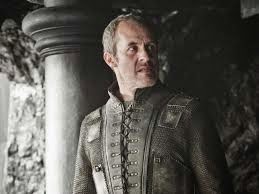
An example from Game of
Thrones, since all of America is watching the series and episodes are aired
several times a week. Season Four
just wrapped up with a patricide of Tyrion’s father, and the arrival of Stannis
Baratheon at the head of an army north of the wall, thus saving the fighters in
Castle Black.
The patricide scene is
surprising and satisfying with many twists and character resolutions, but
linear. Once set into motion, a single character drives the action.

When Stannis confronts the
King of the North in the presence of Jon Snow, a conversation ensues that has
more potential for driving the remainder of the series. The viewer knows these three
main characters more than they know each other. The viewer knows the bodies of
the dead must be burned before dark. The viewer is uncertain of the fate of the
King of the North, or Jon Snow, or how Stannis will manage the influx of
wildings into Westeros. The dialogue of each man comes from his motivations,
resolving long-standing tensions and setting the next season into motion. The
plot folds in on itself.
If a writer tolerates the
uncertainty and exercises patience for bringing the characters into conflict
that serves the plot, then on occasion with perseverance, the writer can ‘witness’
such a resolution within a book series.


