Book Trailer

Showing posts with label fantasy writing. Show all posts

Saturday, December 6, 2014

Blog Archive: Uses for Magic Similar to Playing Chess


When I was a kid, my Daddy taught my brothers and me how to play chess. Only one brother excelled after the first lessons, but the introduction to the game was exhilarating, like the opportunity to make fancy moves (oh, that space is open, so I can move my knight!) and to take the opponent’s queen. What fun!

Later we learned that chess is a game of strategy and the player doesn’t move pieces without a plan. Some strategies are used many times and have names such as a fianchetto bishop or back rank checkmate.  To maneuver into these board structures takes several accepted moves that your opponent will recognize with the very first move.

Magic drives the story:

Some writers are still in the learning stage (from which I never emerged as a chess player) where the intrigue rests with executing exotic moves. The purpose of writing is to explore the uses of magic.

The (often charming) development of magic systems in these stories overwhelms the plot and serves to engage the reader on its own level – sometimes a cloying banquet of magic where the love story or the need for a final battlefield are tertiary.
I place The Last Airbender and Percy Jackson in this category.

Magic enlivens the story:

Some writers have stepped past the stage of fun with magic and use the presence of characters with magic to drive the plot. These writers are similar to chess players who have studied some famous chess strategies and want to employ them in a match. One rule of thumb to recognize this type of writer is that the magic is similar from one series to the next – because the strategies are similar.

I place Eragon and How to Train Your Dragon in this category; formula writing using well-established plot points that delight audience expectation. But we know the outcome by page 60 because we know the strategy with the opening move.

Magic inserted just because we can:

In Theft of Swords by Sullivan, an entire early sequence was about rescuing a wizard from a prison that nobody had succeeded at opening for two centuries. The descriptions were fun and the logical problems intriguing. But when the wizard is free, he says thanks and leaves. I suppose he returns later to return the favor, but I didn’t get that far.

I read (part of) Throne of the Crescent Moon due to a recommendation from Kirkus Reviews. I suppose the readers at Kirkus are jaded and liked the story because the setting, and therefore the magic, was oriental. But the magic was everywhere, in every scene used by every character. I couldn’t follow the story – but I also couldn’t follow Battlestar Galactica, so go figure.

Magic provides a strong ending:

The duel with the basilisk in one of the Harry Potter books is an example of overcoming the raging opponent, after which all questions are settled and Harry can return to Hogwarts or the next term with a fresh slate. And the final duel with Lord Voldemort that winds up the series is a great example of using magic to bring all influences to a conclusion.

Magic is often tamped down in this type of story by the limitations of the user, but serves as deus ex machina in the story climax or end of a trilogy.  I enjoyed The Daughter of the Forest trilogy by Juliet Marillier and cried for the last 60 pages of the first story – something about swans and sacrifice to end a curse.

Marillier’s novels included elements of formula, though, just like with chess moves. A ingénue who is touch by magic but ignorant of its uses, guided by a would-be lover with unwavering devotion, an unrelenting female opponent, along with benign spirits and druids with little to do. Sound familiar?

The third story titled Child of Prophecy repeats these elements for a third generation while the milieu remains static. The climax is a battlefield, of course, where our ingénue enters without a plan, without her magic, and without a weapon, encouraged by spirits to “fake it”. Of course, the gods have a place for her that is not hinted at earlier in the trilogy (that I won’t reveal here), and the gods make all the combatants awestruck while our heroine performs her final farewells to family.

Magic is used sparingly or when necessary:

Some writers use magic to change the story rather than to bolster the story, a subtle difference. I enjoyed reading The Bone Doll’s Twin by Lynn Flewelling, especially the first story that sets up the curse – much like Snow White except the agent of the curse is helpful rather than mean. The reversal of the curse came (close to) the middle of the trilogy and included gender questions for girls-with-swords, so I was intrigued.

The final story Hidden Warrior has an inserted holy man from a different culture who happens along the road at an opportune moment to serve the hero, but he wanders off before the final battle. Once the initial curse was alleviated, the presence of magic was not essential, so the inserted holy man was a maneuver (like in chess) where the reader can see the rationale.

Magic as a developed system:

Brandon Sanderson: ‘nuff said.

The only issue I have with the entire story depending on uses of magic by good guys and bad guys, that Sanderson calls “hard magic”, is that the story becomes predictable, even repetitive. The characters are dependent on skills or discipline to save them and have few other interests.

The Fantastic Four fits this category. Even the bad guy has a power, but must use it in certain ways with specific limitations. The plot revolves around how to trip him up on his own special power.

Magic from a master:

I’m currently reading The Blade Itself (Book I of a trilogy), which is long. Joe Abercrombie uses magic to build the plot and keep the reader engaged. His scenes are episodic (irritating), and too involved with the details of torture (revolting), but the reader feels the cold rain and sword cuts (shows good choices).

Magic is used at surprising moments and differently than a rehash for training dragons. A campfire has a spirit that he can tamp under his tongue to light the next campfire: he, he, he. I’m not but 48% through the book (did I mention that it’s long?), but I have hope that this chess match begins a new strategy that has yet to be named.

Thursday, June 19, 2014

That Certain Feeling of Uncertainty


I sat at dinner with my good friend Lisa who writes non-fiction and bragged that I was well into Book Five of a six book series. “How does it turn out?” Lisa asked.


“I don’t know yet?”
“But how does Book Five turn out?”
“I’m not certain yet.”
“Well, surely you have an outline.”
“Um, I have a genealogy to keep the ages of the young characters straight. And I have a map. Well, a partial map,” I said.

“No wonder you’re stuck.”
“I’m not stuck. I just have to be patient and allow events to unfold organically.”
“How do you tolerate the uncertainty?”
“You know that myth about how all writers are alcoholics…”
“That’s not funny.”

How do I tolerate the uncertainty? How can I explain the process to you, dear reader, or to a fellow writer? I have known long periods of no writing and no creative impulses. It’s like being deaf. Some days I’m paralyzed with fear. Some days I want to throw the whole project out the window, except that’s the same a suicide – identity suicide. Some days I’m so racked with feelings of failure that I, well, let’s just say that I cry in my beer.

Will I ever finish? Will my characters ever reach a wider public? I have come to realize that these are the wrong questions.

One time I had several weeks to myself and a section I wanted to write, so I set an outline and a schedule and kept to them. I used the time productively, I felt, and wrote several pages a day. I placed characters who I knew into situations that were plausible and allowed the dialogue to unfold. I counted words at the end of the day and didn’t allow walks on the beach or long periods of daydreaming to “ruin” my writing time.

At the end of that delicious month I threw out the work, about 80 pages worth. It was forced and too linear. The desire to finish; the desire to make the time pay – these rode roughshod over the willingness to allow the characters to grow organically while I – that’s right; me, the writer – watched the story unfold. I am only the agent of the story with two hands and a keyboard. The characters drive the plot.

I have learned to live with that certain feeling of uncertainty, not knowing where the scene is going. During infrequent moments of pure illumination, I realize how the moving parts fit together. During a walk on the beach, whole scenes unfold in my head where characters get into shouting matches. Over the next days or weeks, I often track back into completed scenes for adjustments. It’s a reiterative process.

I can hear Lisa’s voice in my head. “Is it worth it? Is there ever a moment when you’re glad you squandered the time waiting for the characters to talk to you?”

It’s like a siren’s song. The vocabulary calls to me. The characters whisper in my ear. I can taste the air and hear the seabirds crying, like reaching the port of my homeland after a distant adventure. The other world becomes more real than my daily circumstance.

When the plot folds into itself for a scene where characters who were developed separately come into conflict, when the reader knows more about next events than the characters, when outcomes are balanced on the edge of a knife, when dialogue resolves tensions for several characters at once;  aaahh, moments to live for.

Like the moments at the end of Moonstruck when the family is gathered at the breakfast table and all plot twists are resolved.

My suspicion is that the level of sophistication for a story’s outcome is directly related to the writer’s willingness to be patient with characters and realize them fully for how each responds to new information.

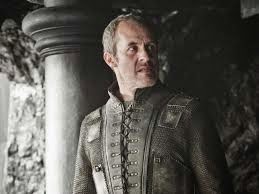
An example from Game of Thrones, since all of America is watching the series and episodes are aired several times a week.  Season Four just wrapped up with a patricide of Tyrion’s father, and the arrival of Stannis Baratheon at the head of an army north of the wall, thus saving the fighters in Castle Black.

The patricide scene is surprising and satisfying with many twists and character resolutions, but linear. Once set into motion, a single character drives the action.

When Stannis confronts the King of the North in the presence of Jon Snow, a conversation ensues that has more potential for driving the remainder of the series. The viewer knows these three main characters more than they know each other. The viewer knows the bodies of the dead must be burned before dark. The viewer is uncertain of the fate of the King of the North, or Jon Snow, or how Stannis will manage the influx of wildings into Westeros. The dialogue of each man comes from his motivations, resolving long-standing tensions and setting the next season into motion. The plot folds in on itself.

If a writer tolerates the uncertainty and exercises patience for bringing the characters into conflict that serves the plot, then on occasion with perseverance, the writer can ‘witness’ such a resolution within a book series. 

That’s worth a lifetime of uncertainty. 


You may also like:

Uses for Magic and Chess


Tuesday, April 22, 2014

No Leads to Yes: Examples for Writers

I saw the Billy Crystal special on cable TV about 700 Sundays where he talks about his youth and how he wanted to be a NY Yankee or a comedian, or a very funny baseball player. I thought about my early ambitions and realized that we come to ourselves through a long series of ‘Nope, not that,’ or even ‘Been there, done that.’

I only wanted to be a writer -- a Great American Novelist. More specifically, I wanted to be F. Scott Fitzgerald. I didn’t want to be Zelda, the wife of a famous writer. The lifestyle was not my focus, but the stories.

I liked how Fitzgerald used anglo words and sneered at the French language that his buddy Hemingway only side-stepped.  I liked that Fitzgerald exposed the pretension of the new money classes and didn’t require a happy ending for a love story.

Later I discovered Lillian Hellman and wanted to be her, except she was so uncomfortable in her skin (when young). She told the stories from the point of view of the women, even though they were victims of the plot rather than driving the plot. Margaret Atwood does something similar, displaying the women as powerless in a stilted marriage or without funds or smarts to make a difference.

But why not a story where the female lead character drives the action?

You will suggest Sylvia Plath, I’m certain. Nope, not that.

There’s Carson McCullers, of course. Southern Gothic was her genre, and I was influenced by The Heart is a Lonely Hunter that I read at an early age. McCullers was sorta chewed up by the NYC writer’s lifestyle, though, as was Harper Lee (To Kill a Mockingbird).

These stories are presented as confessions, a slice of life, illustrations of the era. Plots were outgrowths of situation following that axiom to write what you know.

“Today you are You, that is truer than true.
There is no one alive who is Youer than You.”
– Dr. Seuess

But my life was boring – well-raised, bookish, affluent, Midwestern (not from the South where they seem to suffer more deeply). So … Nope, not that.

I liked action adventure stories like The Perils of Pauline or Love is a Many-Splendored Thing. I wanted the woman to drive a real plot. Why was that so much to ask?


So I read more stories by women in the fantasy genre like Louise Erdrich who brings in mythical elements from Native Americans, and Juliet Marillier’s series about a Daughter of the Forest. The girl protagonist was typically young and imbued with unusual powers of seeing. Other genre writers sent 14-year-old girls into battle in full armor and wielding a 24-inch battle sword. This impossible heroine makes the same choices a guy would make, except she’s gender female (often a cross-dresser like Arya in Game of Thrones). Nope, not that.

I read Robin Hobb’s many series (series-es) that start with The Assassin’s Apprentice. Hobb certainly has the chops for the fantasy genre with immediacy and surprise. (Dragon warming stations: still too funny!) I wondered why the primary character was not a girl. The female characters (in the early series) were relegated to stilted roles of a candle-maker and a misunderstood queen who wielded minimal powers through example and patience. The many lady-aunties accomplished small victories behind the scenes while presenting a benign presence at court. Nope, not that.

Is the same true for you, dear writer who is reading this blog? Do you come to goals for what you want to accomplish by what you know you don’t want to reinforce? Here are some of my standards I impose for my own stories:

·      Girl protagonist (past age 18) who drives the story
·      The protagonist isn’t isolated – knows her mother and sisters and cousins and opponents
·      Real problems that real women have to solve (without pretending to be a boy)
·      Believable obstacles such as no voice in public and no funds to achieve goals
·      A plot that has a crescendo at the end, not slice of life
·      Each character grows during the story arch (even the men)

This last goal is a pet peeve of mine that I call the Lee Remick syndrome. She played opposite Jack Lemmon in The Days of Wine and Roses. They were both drunks and he went through all the stages including getting clean but backsliding. She kicked him out so she could raise their daughter in a stable life, but he visited during his many ups-and-downs. Each time she opened the door, Remick looked the same, not a line on her face. She may have worn the same wig for the whole movie that spanned a couple of decades. Nope, not that.


Tuesday, February 4, 2014

Preparing Fresh eBook Launch

Busy, busy...  Seven Beyond is ready for a 3/1/14 launch as a 99¢ ebook on Amazon Kindle.  Still lining up new release caches for the announcement.  Getting excited, though!

Synopsis:  Dr. Christopher Meenins is 800 years old and doesn't remember his past. Accompanying him on his journey of discovery are the powerful Lady Drasher Elizabeth Tasgneganz, the pedantic Dr. Virgil Grammario, the mysterious—and possibly alien—Linda Deemer. Christopher is haunted by memories of alien places and of a race called the Longists. The group travels to the one place on Earth the Longists might reappear: a remote abbey inhabited by an order of nuns known for their mystical insights and quality brandy.

Memories of David Shanklen—once Meenins’ patient and perhaps also his mentor—trouble Christopher's dreams. Shanklen claimed that he was kept prisoner in an alien zoo maintained by the Longists. Through Shanklen, Christopher must confront the secrets of his past to find the New Restingplace of the Dead.  The travelers exchange stories during his quest à la The Canterbury Tales, and the discovery of the restingplace grows out of their long friendships.

Watch this space for reviews.  If you have a connection or want an interview with the writer, please comment.  

Monday, August 26, 2013

SeaStone: Book V of Dolvia Saga


Monday, July 29, 2013

The Power of Names


I believe in writing with specifics. I tell my students all the time: call it by it’s name.  A stand of trees is a different image than a stand of birch trees.

Two recent events, though…

I committed at a radio interview (six weeks from now) that includes a reading.  That is, the author reading from her own works.  I’m not very auditory – I hate talking on the phone, for example.  I attended author readings maybe five times in my life and hated all of them, except once I heard Michael Ondaatje, the author of The English Patient read from his short stories. I’m a sucker for a crisp accent. 

Except, I’m from the American Midwest living in Chicago.  I have no respect for the letter ‘t’.  With us it’s all dese, dems, and dose over dare. What will my reading sound like over the radio?

Moreover, what scene shall I select for the 5-minute spot?  I review chapter one of the new release StrikeStone that is Book III in a series.  The scenes are sharp and push the story along nicely, engaging a reader who maybe has not picked up the first two novels.  Several sentences in the paragraphs, though, are used to identify characters, such as:

I had seldom contacted Kyle Rula, but received messages through the convent turnkey Sarah, and the Cylay administrator Vera who had been a childhood friend.”

The reader catches up with Sarah later, and also with Vera, but not in this scene that I want to read for the radio.  I need to delete those sentences for the excerpt.  But I start to scan the pages and find a wealth of energy spent signifying on the characters and their back stories.  I don’t want to overwhelm the radio piece with introducing characters that don’t make an appearance in the allotted five minutes. 

To me, the story seems flat after editing, like the remaining characters are acting without responsibility to those who I redacted temporarily.  Actions in the scenes are not undertaken in front of community because I removed the names of people – brother, auntie, daughter, leader –  to whom the actors are responsible.

So I start thinking about how reading in pubic is different from reading in private.  A short piece is different than a novel that’s part of a series.  Adjustments are needed. 

Funny thing, though.

In 2005 I was teaching freshman how to write in complete sentences and asked students in one course to keep a journal.  Since they were required to, I also started a journal – three 3-page entries each week that were reflective and confessional.

Recently, I posted some of the short writing pieces from that effort on a new eblog titled Writing in the Short Form, intended for my current creative writing students (in September) who I will guide to write short fiction in their own voices. “Bare yourselves; dig down to the bone; throw away caution; expose the dark side for fear and jealousy.” Sound familiar?

I sent the few first posts to a friend who said, “Yes, the posts are too personal, and you should change all the players’ names.” 

I hate the idea. 

I know this feeling is only process frustration. The end-reader knows little about my lofty goals and my compromises. So I changed them, (Marty for Michael and like that). The re-naming effort takes all the hurt out of the paragraphs, like it’s somebody else’s story now.  Marty isn’t responsible like Michael was. Go figure.

What’s in a name? Designer names for our clothes; names of countries we want to visit; names of villains in Spiderman movies; the name for the pill needed to stop my skin from itching.  Names are everywhere, and if we cannot recall them, we cannot have the benefit of the fashion or geography or camaraderie or healing.

Sri Lanka was Sinhala in India, and Taprobane to the ancient Greeks. On a store-bought globe, the island country was identified as Ceylon until 1972.

You tell me.  Sample the short works on the eblog that my students will use. Do the names have power?  

 http://tinyurl.com/kbnfugl


Tuesday, July 9, 2013

Interview with Stella Atrium


Q: How is it going with the release of Book III in a fantasy series?

Atrium: StrikeStone just entered the pipeline for distribution the first week of July 2013, so sales can’t be tracked yet. We did a Goodreads giveaway for Book I -- titled SufferStone -- that got great response, though.

Q: What are the drawbacks to writing a series?

Atrium: Well, my stories are about the women, so there are fewer battle scenes and gory deaths. Characters include the fate of the set-aside wife, or a tribeswoman who maneuvers behind the scenes to promote her son as leader, or a businesswoman who courts the men while she ignores the talents of her niece.  The battles mostly take place over the hill while the women try to gather remnants to hold together a society.

Q: Sci-fi fans don’t like stories about women?

Atrium: That depends on where you look for fans.  Not to speak against Reddit, but I’ve had more luck with engaging fans on GoodReads and World Literary Cafe.  Also some readers don’t start with a fantasy series until at least three books are in print.

Q: Are more books planned for the Dolvia Saga?

Atrium: Book IV -- titled SignalStone -- is mostly written, but I’m polishing the last section to foreshadow Book V that’s just underway this summer.

Q: Does the reader need to read the first two books to understand events in StrikeStone?

Atrium: Thanks you for asking. Rabid Readers Reviews read an advanced copy claimed she understood StrikeStone just fine without the first two, but she wanted to go back, then, and pick them up to read. I hope other readers have a similar reaction.

Q: How many books in the series are planned altogether?

Atrium: Six is a good number. It’s important to complete some story threads for each book, but leave the reader wondering about what happened to other characters.

Q: How do you balance all those characters and keep them clear in your head? 

Atrium: Each character has her own quirks and way of seeing the world. Tribespeople on Dolvia have a tight community where each is needed to balance the harmony. I like to allow them to grow and see how each acts in a crisis or as an adult after some catastrophe. The characters are people to me, so I’m always returning to see what happens next.

Tuesday, February 12, 2013

Luck in the Shadows by Lynn Flewelling
by Stella Atrium 2/12/13
_________________

I love castle stories. What could be better than a 350-page fantasy novel that starts with three companions on horseback carrying swords and Radly bows crossing a frigid field to escape the bad guy or to rescue the princess?

I celebrate that there’s no end to these horse-and-castle stories, and I investigate whatever’s new. Some novels like A Quest for Heroes by Morgan Rice are calibrated for a juvenile audience and the heroine is too young for insights I would seek. Some stories follow the new trend of heaps of gore and lists of knightly heraldry like The Wilding by CS Freidman.  For some stories I don’t buy the second book in the series because not enough surprises held my attention during the first outing, like Blood of the Falcon by Court Ellyn.


Golden_FoolI picked up Luck in the Shadows because I had enjoyed all three Bone Doll’s Twin stories, and especially the gender-bending twist.  The witch who lived in the forest and the young magician who she trained were diverting enough for use of magic.  Though the three stories lagged in places, a whimsical holy man arrived like a breath of fresh air to resolve some plot difficulties.  A 15-year-old girl in full armor and long sword at the head of an army to save the empire was a bit of a stretch, but at least she was a girl, and she had female relatives who had roles in the plot (more than decorative).

But…  I would call Flewelling’s Luck in the Shadows a lighter version of The Golden Fool by Robin Hobb.  Over the past two decades, Hobb wrote four series (series-es) around the enduring friendship between a fool with a mysterious background and an apprentice to a wizard.  There are same-sex undertones, but each becomes the beloved to the other through their many adventures.


Luck_ShadowsFlewelling’s Book I of her Nightrunner series presents a watcher with a longer life than many, a wizard who commands spells for shape-shifting and message bubbles, and an orphan (why is it always an orphan?) who is a quick learner (why is he always more gifted at picking up dark skills?). Without a girl/boy love story to carry the reader through the MANY discussions of the heroics of former queens, and more discussions of the dead wizards who helped the dead queens, getting to the end was a struggle.

I don’t care about those old queens.  I have no context for those old queens. More living female characters who have roles in the plot -- other than decorative -- please.


Flewelling presents a bad guy (why do they always have no redeeming value?) who pursues our watcher and apprentice, but she drops this story line in the middle of the book in favor of describing the needed lessons in swordplay for the apprentice (why are long descriptions of training with swords required for fantasy writers?).

IcefyreThe struggle in the final act means the watcher and apprentice fight on the side of the current royal family for whom only three scenes were spared, and vanquish a long-simmering blood feud for which only two scenes were constructed.

Again, the reader doesn’t feel invested in solving the problem at hand, especially since the resolution was a matter of home invasion and a fire contained in a single room. A comparison to Hobb’s white queen in Fool’s Fate comes to mind, wherein the queen lost her captain, her familiar, her ice castle, and her hands before her suffering ended.

wogf_200The bad guys in Flewelling’s story had not shown their faces again by the end of Book I, but the homoerotic undertones were coming to light. If there were more surprises, fewer long-winded stories about dead queens, less description, more jeopardy, more hetero romance – then I could overlook the disjointed plot.  I doubt that I pick up Book II.


Saturday, February 9, 2013

Among Others by Jo Walton: A Review
by Stella Atrium 2/9/13
_________________

Among_OthersAs my next review for the WWE 2013 Women in Sci-fi Genre Reading Challenge, I chose Jo Walton’s Among Others, which I assumed was written in the 1980s since the main character discussed at length classic sci-fi stories available in Britain during that decade. I’m glad I finished the story before I read the press about Jo Walton and how she edged out GRR Martin for the Hugo Award last year for this work.

Her Hugo win is only logical considering that the story is more about engagement with classic sci-fi books than any other theme. The reviewers for the Nebula and Hugo awards must have thought Among Others was a smorgasbord!

I’m equally glad I didn’t know the story was called a ‘reverse Harry Potter’ because I would not have started it for that very label.  Derivative works are not my cup of tea. The story is written in the voice of a Welsh girl named Mori who doesn’t know her father and hates her witch mother and is sent to an English boarding school that harbors NO magic – no possibility of magic since objects are held in common. I can see how that plotline gained the label.

**spoiler alert here**

Mori and her twin Mor spend a rich childhood communing with Welsh fairies and avoiding the cruel acts of a demented mother. The fairies enlist them to diminish the powers of the mother, but along the way Mor is killed and Mori is crippled.

Two facets of the story make it a classic. First is the unfolding explanation of the magic of English fairies and how ‘it’s so deniable’, expounded through the filter of a sheltered 15-year-old who reads too much and is overly concerned with ethics. The second is the genuine responses to sci-fi stories Mori reads that are placed ahead of friendships among school chums, or reconciliation with a distant father, or a budding romance with a town boy.
I had read many of the sci-fi stories Mori claims to love (and at that same age), so I was in on the in-jokes. Defining the events of her life through examples from the stories – looking to Asimov and Zelazny for direction in a crisis – was unique, funny and delicious.
hitch_hiker

I liked that Walton choose the decade of the 1980s for her setting, ignoring world events but celebrating the gift of A Hitchhiker’s Guide to the Galaxy, newly published. The world of Wales and Britain seemed quaint (County as Walton called it) and confined without the internet or a true connection with America that was the center of sci-fi publishing. The discovery of local fan conventions seems like finding Nirvani to Mori.

Sci-fi fans and would-be writers today discuss systems of magic all the time on Reddit – who got it right and who was copying from the other – high and low fantasy; soft and hard magic. Walton takes a respect-for-magic approach, and Mori worries that changing one event means so many events in the past and future must also change. Mostly, Mori uses magic, of which she seems strongly imbued, only when asked by the fairies and then only if the act does no harm. The one time Mori uses magic on her own as protection against her mother, and also requesting a karass, she worries later that all friendly gestures toward her are magic-bound.

ZelaznyThis is a coming-of-age story, though, with no save-the-world tropes and few insights beyond what a perspicacious 15-year-old can glean from family and books.  The book is brill, wholly charming and worth the investment of a rainy afternoon. And I ordered out-of-print Zelazny books for my next read.

Monday, January 14, 2013

Remnant Population: A Look at First-Person Narration

moon 
Elizabeth Moon is a controversial writer both for her writings and for her stance on social issues.  She’s a favorite of the feminists in science fiction crowd and broke ground for women writers competing for awards in a genre that was claimed for many decades as men-only. Because of her notoriety, many female writers received a fairer hearing from agents, publishers, readers, and award groups. Kudos!

Characters in the works of Elizabeth Moon are often women past the age of romance and child-bearing who struggle to find voice in a repressive family or community – one of my favorite themes. I will mention specific plot points in this review, so **spoiler alert**.

remnantRemnant Population is narrated by a solitary 80-year-old woman named Ofelia who secretly stayed behind when the failing colony was evacuated offworld. She resisted decisions made for her by her son, by the corporation that owned the colony, and (implicitly) by her long-dead husband.  When a rescue team arrives years later, she must find her voice to resist deportation, but also to negotiate the relative rights to technological advances for the indigenous and intelligent creatures.


Ofelia reminds me of Grandma in Edward Albee’s An American Dream who has no voice within family. She is constantly shipping out boxes, and eventually follows her shipments to escape a repressive domestic fight.

esslinThis archetype follows the idea of the “affirmative no”, meaning that to realize her complete self, she must say no to loved ones. This concept was articulated in Martin Esslin’s Theatre of the Absurd where he discusses the plays by Albee along with Brecht, Beckett and even Sam Shepard.

Ofelia achieves her “affirmative no” when she hides to avoid the shuttle flight. She enjoys the solitude of the abandoned village even though she worries about her age and failing health.  The pacing is good. The number and difficulty of obstacles Ofelia overcomes is engaging for the reader (similar to Oryx and Crake by Margaret Atwood).

Additionally, Elizabeth Moon deftly handles a classic problem of how to report plot events that are beyond the sightline of the first-person narrator. Ofelia hears the struggle over an abandoned “weathersat” when a colony ship 200 kilometers distant has to abort the landing mission because the indigenes mount a successful attack. Ofelia is sorry for the offworlders who she identifies with, and is afraid of the indigenes who she eventually befriends. The reader quickly sees that later in the story Ofelia will serve as an ombudsman between these groups.

Herein lies the problem. How does the writer present the worldview of the indigenes? How does the writer present the group dynamics of the rescue team before they step off the shuttle? A solitary narrator can only assess what is in her sightline and from her POV.

Moon resolves this writerly problem by inserting scenes from the group-think of the indigenes using a specific vocabulary, and scenes from the POV of one member of the rescue crew named Kira. These scenes are not separate sections, but presented as the next paragraphs within a chapter. But then, I read the story on Kindle where standards for section breaks are still evolving.

I found the group-think scenes charming and valuable for increasing the nuance of later encounters with the indigenes. I found the POV scenes for Kira wholly unnecessary. The crew was stereotypical for arrogant scientists, and their gestures after landing told the story of tensions in the group.  In fact, Moon includes a well-written scene between Ofelia and the “enforcers” of the crew who are not included in the expedient exposition of Kira’s POV scenes.

For overall balance, though, if the Kira POV scenes were deleted, what justification remains for the occasional group-think scenes from the indigenes? Both or neither may have been the final (editor/publisher) decision.

Aspiring writers who struggle with the temptation to pause the first-person narration and present an alternative POV within the story can take a lesson from how Moon resolved that need in Remnant Population.

Thursday, January 10, 2013

Twitter Friends vs Fans
by Stella Atrium
__________________

Before iTunes, Smashwords and 99¢ eBooks on Kindle, the rule of thumb for a performer who wanted to attract the attention of industry big wigs was to show that he had 1000 loyal fans. We are in the Wild West stage of selling books just now where anything goes and the lowest bidder wins the most traffic.  But traffic and fans aren't the same creature.

A fan tells friends about his favorite performer (like a review), plays the tunes at parties (like a book chat group), and wears a t-shirt with the band logo (like buying a paperback). A fan RETURNS for more products from the same performer and puts down her money at retail prices.

I don't understand free ebooks on Kindle or Smashwords.  The writer spends all her life writing this book at the sacrifice of so many other activities and time with loved ones. Why devalue the product?

I'm not convinced Twitter traffic translates to sales, either. I see writers promoting each other, or cross-promoting with reviewers and handlers.  The writer is like a candidate surrounded by members of the press and cannot reach past the loud-talking reporters to find a voter willing to shake hands.

Maybe the audience we are seeking aren't even among our followers on Twitter.

Years ago I fooled around in non-profit theater in Chicago where attendance was one-quarter house on a good night and theater groups lived for reviews in The Reader and grants from Thorten Foundation. The truth was that no matter how well produced the performance for acting, directing, or set direction — the audience for live theater was sparse, even at low ticket prices. A producer in this arena could not expect to see returns on her investment.

The plethora of giveaways on sites trying to build loyalty (for the site, not for the writer) is similar to non-profit theater in Chicago. Except for a couple break-out sites that facilitate the reading community like GoodReads and LibraryThing, the audience just isn't there.

How does the self-publisher gain those "1000 loyal fans" for convincing evidence that her writing rises above the pack and is worthy to become a book-of-the-month choice for reading clubs?

Reputation is everything. There are several levels of reputation, though. Listed are 10 types to avoid.

    1.    The Situation — Anyone can show his navel and get others to look.  Be sure there's integrity and a reason the fan should return.
    2.    Always free — If it's free, that means you couldn't get anybody to buy it. Have a little dignity.
    3.    Trading favors — My back doesn't needs scratching. Because you asked, I know you haven't found true fans yet.
    4.    Inflated claims — "If you liked Jurassic Park, you're gonna love my self-published book." I always turn away when the writer claims to be like some other writer.
    5.    Five-star fan reviews on Amazon — Really? Were they posted by your mother?
    6.    Twitter Blanket — the same note every two minutes announcing the launch of your book. Your followers already read the announcement. Nobody else sees it. Who are you talking to?
    7.    Begs for reviews or retweets — Be patient, a quality reviewer will find a quality book soon enough. Building brand loyalty only happens over time.
    8.    Writer blog tour — Sponsored by another writer in a chat room where only writers sign in.
    9.    Salacious claims to increase traffic — Fool me once and "unfollow" is my next gesture.
    10.    Purchasing followers — Get real!